
What’s Really Happening When Your Executive Team Doesn’t Trust Each Other?

Trust in action: Oleg Pavlov, Founder and CEO of Quadrum Global with Craig Clark, Co-Founder of Momentum Consulting
Hint: It’s Not Always a Personality Problem.
Many executive teams we’ve worked with over the past two decades have, at some point, tried to solve a trust problem by changing the people in the room.
A CFO who won’t stop undermining the CMO in meetings. A VP who nods along in the leadership meeting and then does something completely different and out of left field once they’re back with their own team. A CEO who has quietly concluded that they’re the only one at the table actually carrying the business.
The instinct is to call this a personality problem. That person is difficult. That person isn’t a team player. If we just replaced them or sent them to a communication workshop, the friction would go away.
It rarely does. And that’s because it often isn’t about personality alone.
The problem isn’t always the people. It’s also the seats they’re sitting in.
Every executive at the table has a partial view of the organization. The CFO is accountable for the numbers. The CMO is accountable for growth. The COO is accountable for what actually gets delivered.
Each may be acting rationally from their role's perspective while seeing only part of what the organization needs.
When that structural tension goes unnamed, people begin to misread it as character. What the CMO experiences as undermining may not have begun as a personal attack. It may be two leaders optimizing for different, sometimes competing, mandates without a shared way to examine the tension between them.
Replace the CFO, and in eighteen months, you may find yourself having the same conversation about someone else.
That doesn’t mean behavior doesn’t matter. Sometimes someone really is avoiding accountability, withholding information, or refusing to collaborate. You can't rebuild trust by explaining away harmful behavior as a product of the system.
But dysfunction isn't always explained by who is in the room. Often, the system the room operates within sustains it.
This is one of the most consistent things we see across the executive teams we work with, whether we’re working with a mining company managing safety and shareholder pressure simultaneously or a bank balancing growth targets against the trust of its customers.
The question is whether the room has ever learned how to name those tensions honestly—and tell each other the truth about what is actually happening.
Why nobody says anything
Here’s the part that doesn’t get said out loud in the leadership meeting, but that we hear constantly in private conversations with the executives we work with:
I don’t get honest feedback anymore because I’m the boss.
I’m the only one who seems to be carrying this.
I’ve stopped bringing certain things up because the last time I did, it became personal instead of productive.
This is a genuinely strange position to be in. You’ve spent twenty or thirty years building the expertise and track record to sit in that seat, and the more senior you become, the less honest feedback you actually receive.
Direct reports filter what they tell you.
Peers manage the relationship instead of naming the tension.
Boards want confidence, not candor.
The result is a kind of isolation that has nothing to do with being surrounded by people and everything to do with not having anyone who will tell you the truth.
An often-cited study found that half of CEOs felt lonely in the role; among those leaders, 61% believed loneliness hindered their performance.
Not because they lacked company, but because they lacked a place to speak honestly without it costing them something.
That isolation doesn’t stay contained within the individual leader. It starts to affect how people interpret one another. Questions become assumptions. Disagreements become judgments about motive. Eventually, leaders stop testing what they think they know and start acting on stories they have never actually confirmed.
What actually changes it
The fix isn’t simply a personality assessment, a performance review, or another reshuffling of the organizational chart, hoping the next person will get along better with everyone else.
What actually shifts an executive team is naming the system honestly and changing how the team operates within it.
This needs to start with the most senior person in the room going first.
During our team off-sites, we’ve watched CEOs open a session by plainly acknowledging—and taking full accountability for—the places where they had been making decisions unilaterally because they didn’t trust the team to wrestle with the full complexity of the business.
It’s uncomfortable.
But it creates an opening for the team to begin telling the truth, because someone with real power has just demonstrated that it is safe to do so.
That moment does not rebuild trust on its own. It creates the conditions for rebuilding trust.
The team then has to clarify its shared priorities, surface competing commitments, define how decisions will be made, and agree on what accountability will look like after everyone leaves the room. It must establish a way to disagree without making the disagreement personal and repeatedly demonstrate that candor will not be punished.
Truth-telling matters, but it needs a system that makes telling the truth useful.
When that candor is met with curiosity rather than punishment, the team starts operating differently. This is the part our clients consistently describe as the real payoff.
It isn’t only that the meetings become more productive and problems get solved more effectively, although they do. It’s that something inside the executive begins to quiet down.
Leaders tell us their internal voice gets quieter. They start sleeping again. They stop running the organization in their heads at 11 p.m.
One executive told us that, after doing this work with her team, she felt as though she had been handed back the capacity to focus and get things done. Not because her job had become easier, but because she was no longer spending half her energy managing dynamics that had never been named.
It’s exhausting to spend your energy guessing what other people are thinking or why they’re behaving a certain way when you could ask them directly.
That outcome rarely comes up in leadership development conversations because it sounds too personal for a business case.
But it is the business case.
A leader who is no longer carrying the whole organization alone is better positioned to make sound decisions, build a stronger bench, and remain effective in the role. The executive team can also become more intentional about co-creating the culture it is committed to building throughout the organization.
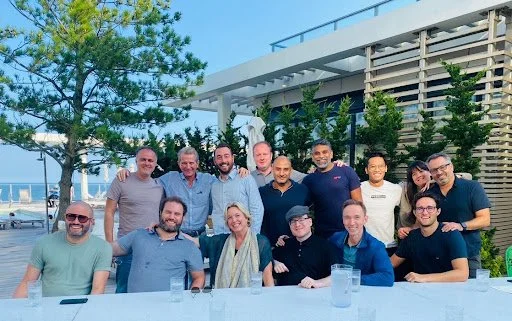
Trust in action: The Quadrum Global team during an off-site at Asbury Ocean Club in New Jersey.
The question worth asking
If you’re on an executive team right now, here’s a useful test:
Think about the last time a meeting ended with everyone nodding while you privately knew that nothing had actually been resolved.
That isn’t merely a communication-style problem.
It may signal a trust problem, and many trust problems begin structurally before they become personal.
They can be named and rebuilt. But because the team is part of the pattern, it can be difficult to see—or interrupt—that pattern from inside it.
An experienced outside facilitator can help the team name what has become normal, surface what is not being said, and build a more productive way of working together.
That’s the work we do. Not to fix anyone’s personality, but to help the team see the system it is actually operating within and build the kind of trust that allows people to tell each other, and themselves, the truth.
As always, all my best,
Momentum works with executive leadership teams to rebuild trust, communication, and alignment at the top through executive business coaching, executive consulting, team training, and team off-sites.
If today’s topic hits close to home, let’s talk. Reply directly to this email or visit our website.
Fundamental of the Week #20: APPRECIATE AND ACKNOWLEDGE
Regularly let people know you appreciate their qualities. Being acknowledged for a task well done is important; being acknowledged for a character quality is lasting.
Momentum Consulting offers executive business coaching, top-level executive consulting, team training, and team off-sites to build and transform your business to the next level. Inquire about business consulting and leadership coaching today.